Cleverly AI
AI-assisted grading that shows its work, so teachers can trust it.
Manual grading does not scale for South African schools, colleges and universities. The obvious fix, AI that grades for you, runs into a harder problem: a teacher will not accept a mark they cannot see the reasoning behind. Cleverly is built around that tension. It does the heavy lifting, then shows its work.
The brief
Teachers were spending evenings and weekends marking, and institutions had no consistent way to moderate across markers.
Any AI that touched a learner's mark had to be explainable to the teacher, defensible to a parent, and compliant with POPIA.
Constraints
- Handwritten scripts: OCR had to handle real handwriting without sending every page to an expensive vision model.
- Unit economics had to work at a school's budget, not an enterprise's.
- No lock-in to a single model vendor; the market changes monthly.
The system, piece by piece.
- 01
A vendor-neutral AI provider layer
The grading engine talks to a provider interface, not a vendor. Models are swapped or tiered by cost and task from configuration.
- 02
Evidence-linked, rubric-aligned grading
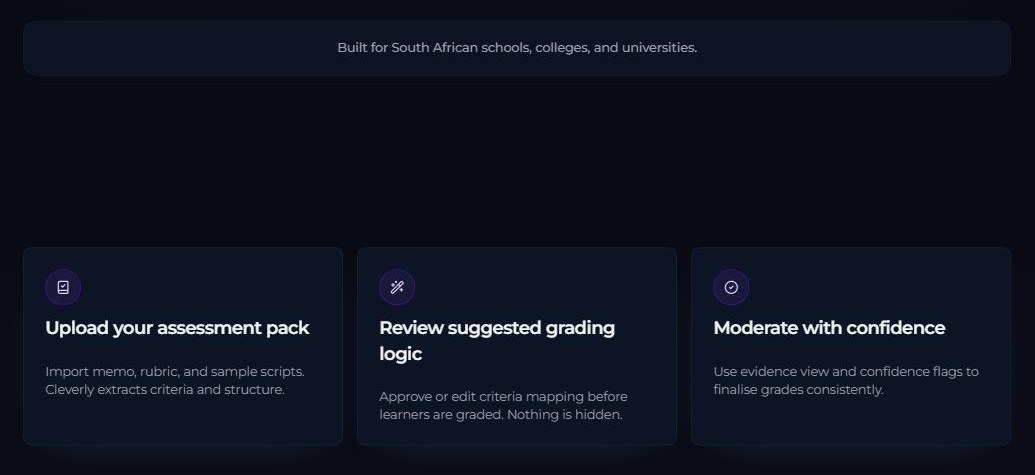
Every suggested mark points to the rubric line it satisfies and the passage in the learner's script that earned it. The teacher moderates in a review step before anything is final.
- 03
A tiered OCR pipeline
Free text-layer extraction first, vision models only for the scripts that need them. Cost tracked per script.
- 04
The platform
Next.js client, Express and BullMQ workers, Supabase Postgres, deployed on Vercel and Render with CI and automated tests.
The calls that shaped it.
Teacher in the loop, not teacher replaced
The product is a moderation tool with a very good first draft. That framing decided the interface, the data model and the sales conversation.
Evidence links as the core data structure
Linking marks to rubric lines and script passages is more work than returning a number. It is the only reason the mark is trusted.
Prompt caching and model tiering from day one
A grader that costs more per script than a human is a demo. Caching, tiering and per-script cost telemetry are what make it a business.
Outcome
In private pilot with South African institutions. The cost controls are what separate the pilot from a demo: a cheaper model tier has been validated for grading quality, and every script's cost is known.
Credits
- Architecture, AI systems, infrastructure and DevOps: Oryares's founder, as cofounder and CTO.
- Product and go-to-market with the Cleverly founding team.