
Fix the process first.Then build the system.
For law firms, estate agencies and medical practices. Your team loses hours every week to enquiries, follow-ups, client updates and paperwork. We find where those hours go, fix the process, then build the automation and AI that keep it fixed. You see the time saved, a person approves what reaches your clients, and everything has an off-switch.
One ordinary day, handled.
The work that interrupts everything else, taken off the desk hour by hour. The person who serves clients goes back to serving clients.

Overnight enquiries have replies
Messages that arrived after hours were answered with your availability and a way to book. The reply is in your words, and you can read every one.
Paperwork arrives sorted
Intake forms, scans and long emails are summarised and filed, so the team reads a paragraph instead of a pile.
Reminders already went out
Clients were nudged yesterday. Fewer empty slots, and nobody spent the morning phoning around.
Follow-ups send themselves
Quotes, thank-yous and review requests go out on time, after you approved the wording once.
The practice still answers
A new enquiry gets a reply, two slots and a way to book. The light stays on when the desk is empty.
Every automation has a human gate and an off-switch. A process is proved by hand before it runs on its own. How this works for practices →
Every company has seen the demo.
What happens after it is where most AI budgets go to die.
- 01 / DawnThe demo
A vendor shows a model answering questions about your documents. It is impressive. Everyone in the room nods, and someone asks for a quote.
- 02 / NoonThe pilot
A freelancer or an eager internal team builds it in three weeks. It works beautifully on the ten documents it was built with. The invoice says done.
- 03 / DuskThe silence
Six months later it answers a customer wrong. Nobody can say why, nobody owns it, and the person who built it has moved on. The light that was so bright in the demo is out.
Most AI projects die between the demo and the deploy. Oryares keeps the light on.
One accountable technical lead carries the idea from above to below: from the demo to the system that real users run on, with evals, monitoring and a person whose name is on it. The sun does not go out at dusk. It needs something to carry it through the night.
Three kinds of work.
Each one takes a part of the mark. Take one, or all three. The same person runs each.
- 01Process and AI implementationTeams with a feature idea, a pilot that stalled, or a vendor quote they cannot evaluate.A two to six week sprint, fixed scope.
- 02Technical advisoryFounders and operators who need senior technical judgement without a full-time hire.Ongoing advice and oversight, scoped to what you need.
- 03Product engineeringBusinesses that run on spreadsheets, a no-code tool that has hit its ceiling, or a legacy system nobody wants to touch.Four to twelve week builds, milestone billing.
Proof it has worked before.
One system shown in full, and the person who built it.
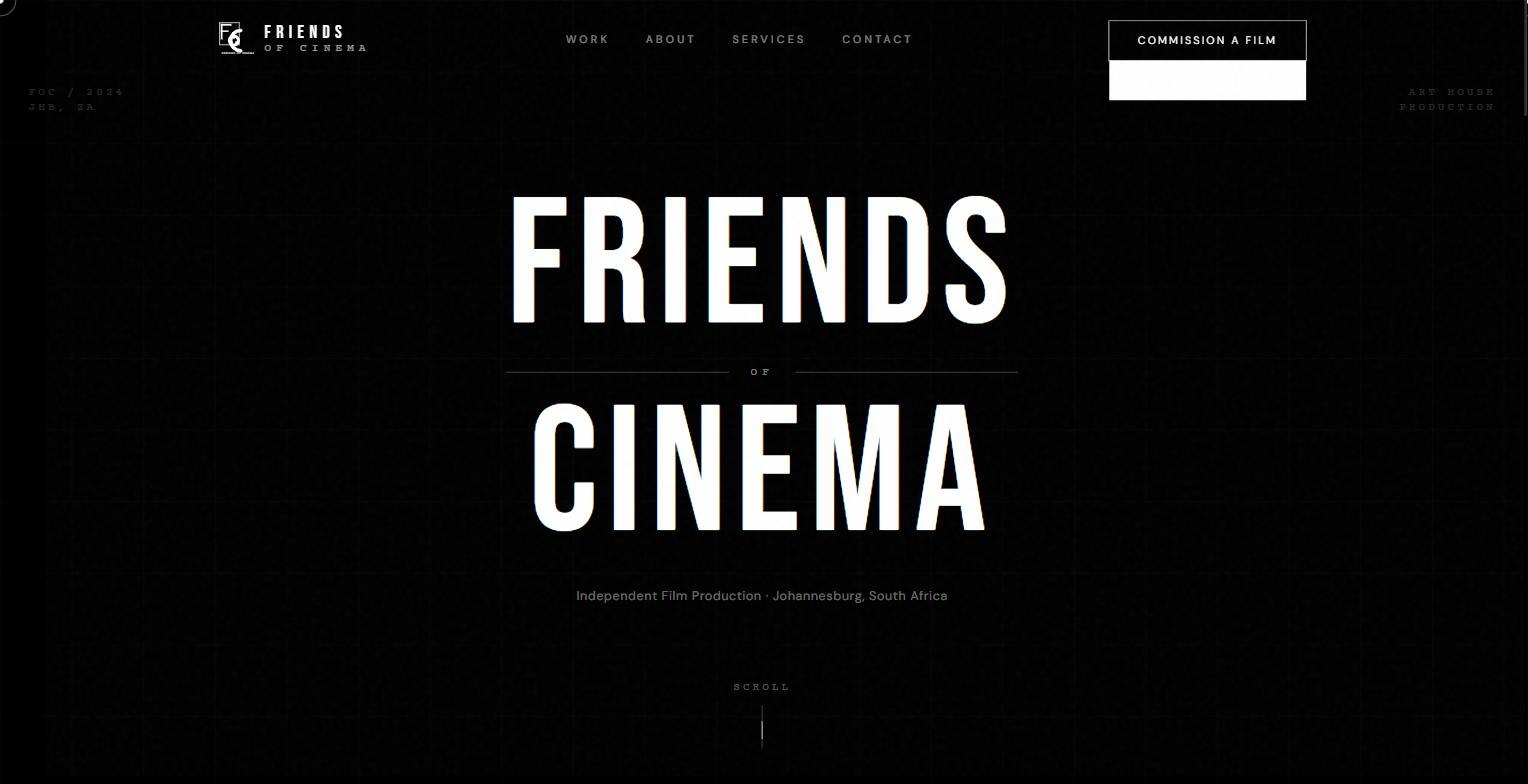
Friends of Cinema
A site that feels like the films, for a studio that makes them.
An independent production company needed a website that felt like the work: art-house, editorial, slow where it should be slow. Not another templated agency homepage. For a creative studio the site is itself a portfolio piece, so the brief was craft first.
- Design and build
- Solo
- Developer hours to update content
- 0
- In production
- Live
One engineer, accountable end to end.
Oryares is led by a full stack and AI engineer in Johannesburg: cofounder and CTO of an AI grading platform built on Claude with retrieval, and CTO of a tutoring marketplace migrated from no-code to Next.js. The same person runs your project from the first call to the system you use every day. Fluent in English and French, working across Africa and Europe time zones.
- Engagement size
- 5 to 15 hours a week, or a scoped sprint
- Typical first step
- A one to two week technical audit
- Stack
- Next.js, Node, Python, Postgres, AWS and GCP, Claude and OpenAI
- Where
- Johannesburg, remote across Africa and Europe
What happens when you write.
No sales funnel. Three steps, each one you can stop at.
- 01
A reply within two business days
A short, honest answer about whether Oryares is the right fit, and if not, who might be.
- 02
A free 20-minute call
You describe the task that eats the most time. You leave knowing roughly how many hours it costs you, whether automation would pay for itself, and a clear next step either way.
- 03
A written audit proposal
Scope, timeline and a fixed fee for the audit. If it reads right, the work starts the following week.